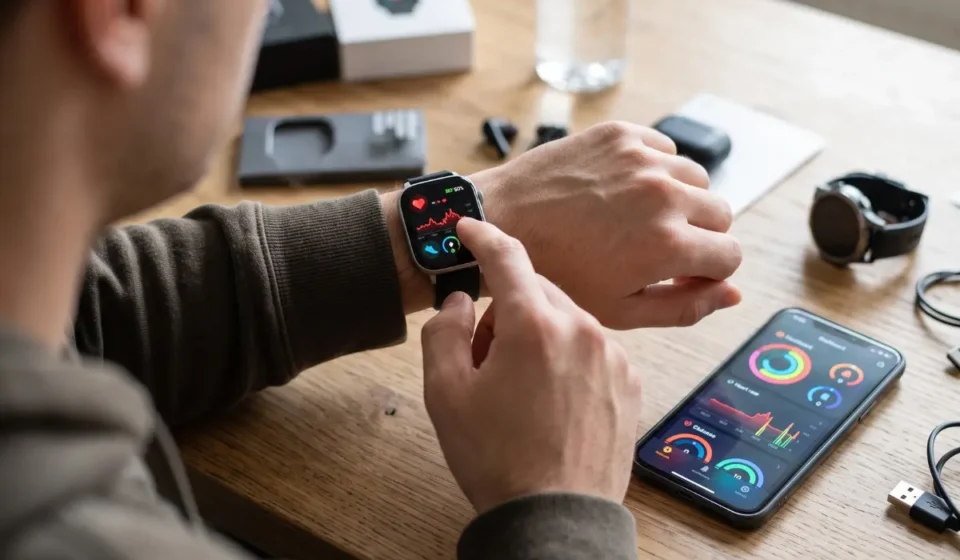

Although buying a smartwatch on a budget means you may have to sacrifice some appealing features, the benefits are hard to ignore. Whether it is measuring your fitness or notifying you of incoming phone calls, a smartwatch can help you achieve more each day without costing you a fortune. Despite that, not all smartwatches are equal, and you will not find all the same features on a similar-looking model.
Before you select the best smartwatch for your daily use, it is a good idea to look past the screen size, advertised features and elegant appearance. While some basic fitness trackers and smartwatches offer reliable everyday features within your budget, others might boast an impressive list of gimmicks that fail to deliver on their promises.
This article will show you the essential features to look for when buying a budget smartwatch, including the display, battery life, health and fitness tracking, GPS, water resistance and app compatibility. You will also learn which features to prioritise, which you can do without and how to compare the available options to make the best choice.
What to Look for in a Budget Smartwatch
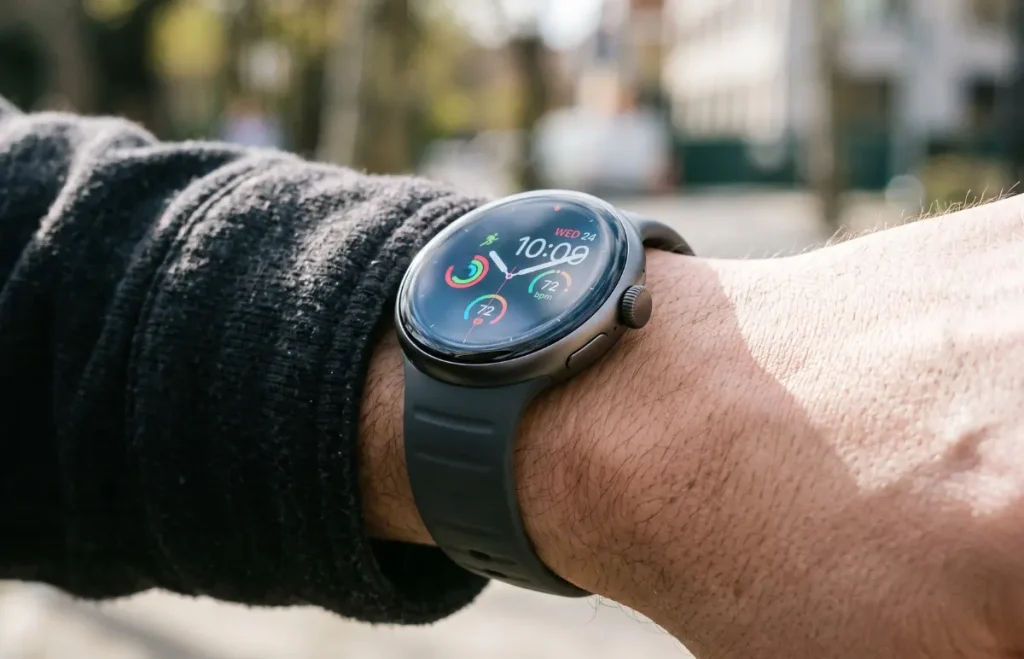
There are several essential features to consider before you buy a budget smartwatch, including battery life, the quality of the display, the availability of health and fitness tracking features, smartphone compatibility, water resistance and the overall design. You should also take note of whether the GPS, Bluetooth calling and companion app features perform as described rather than simply relying on the specifications listed on the product page.
Here are eight factors to consider when choosing the best smartwatch for your money.
1. Display Quality and Outdoor Visibility
The display quality of a smartwatch is one of the most important factors to consider in relation to its daily use. Most cheap smartwatches utilise either an LCD or an AMOLED screen, and knowing the strengths and weaknesses of each will help you get a better idea of what to expect from the technology on offer.
AMOLED displays tend to deliver deeper blacks, richer colours and greater contrast, while LCDs are generally more affordable and do not suffer from the same issues with visibility in bright sunlight, provided the display brightness is sufficient. The most suitable option will depend on your personal preferences and budget.
Here are some of the display specifications you should look for before you buy a budget smartwatch:
– The viewing technology should take your specific needs into consideration, as AMOLED and LCD displays tend to behave differently.
– Display brightness should be good enough to ensure that the on-screen content is always visible.
– Touch response should be quick enough to prevent excessive tapping when dismissing unwanted notifications.
– Resolution and size should be easy on the eyes without stretching across your entire wrist.
– An always-on display can be useful, but it might reduce battery life significantly.
In most cases, a display with bright colours and a decent resolution will be more important than an expansive touchscreen with distracting effects that you will barely use.
2. Battery Life and Charging Convenience
When it comes to evaluating the battery life of a budget smartwatch, one of the most important aspects to consider is its practical everyday use. A watch that constantly needs recharging can be incredibly annoying, especially when it fails to keep track of your sleep patterns or measure your fitness.
The advertised battery life will typically be affected by the features you use on a daily basis and the extent to which you use them. Always-on display, GPS, Bluetooth calling and frequent tracking measurements can affect the endurance of a smartwatch, and its performance will also change depending on the conditions under which it is being used.
| Battery feature | What to look for |
|---|---|
| Advertised battery life | Check the conditions under which the figure was measured. |
| Typical daily use | Look for independent reviews that describe real-world endurance. |
| Charging time | Check how long a full charge takes. |
| Charging connector | Confirm that the charging cable is included and easy to replace. |
| Battery performance with GPS | Check whether workout tracking significantly reduces endurance. |
Practical tip: If you are primarily interested in receiving notifications, measuring your steps and occasionally tracking a workout, a good battery life will be more important than advanced fitness tracking or other rarely used features.
3. Health Tracking and Sensor Accuracy
Many cheap smartwatches offer fitness and health tracking as standard, although not all of them have the same degree of accuracy. While most budget devices boast an array of sensors, such as those that measure heart rate, blood oxygen levels and sleep patterns, the results they provide are rarely reliable.
If you are considering a fitness tracker or a smartwatch with health-related features, make sure to read up on the accuracy of the given smartwatch before you buy it. In most cases, heart rate, blood oxygen, sleep tracking, stress tracking and step counting features should be viewed as general references rather than reliable medical readings.
Do not be fooled by a cheap smartwatch that promises extraordinary medical results. A simple device with reliable everyday features will be significantly more useful than a complicated one with unproven health benefits.
4. Fitness Tracking and Sports Modes
If you are a serious athlete, make sure to look for a smartwatch that supports the type of sports you enjoy. Although it might be tempting to choose a product that offers a long list of fitness-related activities, not all of them will be relevant to your daily use.
For running and other outdoor activities, features such as workout duration, distance, speed, calorie estimation and heart rate tracking can be useful additions. If you do not enjoy running outside, look for a smartwatch that includes additional fitness tracking features, such as a treadmill mode or an indoor cycling option.
If you are a casual gym-goer, basic step counting and workout tracking features will be sufficient. Outdoor runners and cyclists, on the other hand, should look for features such as GPS support and workout recording options.
5. GPS and Location Tracking
GPS can be a very useful addition to a smartwatch, especially if you enjoy running or cycling outside and do not want to carry your phone with you at all times. However, not all budget smartwatches include an internal GPS receiver, and some of the advertised features might require you to rely on the location data from your phone instead.
There are essentially two ways to utilise the GPS tracking features in a smartwatch. The first method involves using a standalone GPS receiver, while the second option makes it possible to use the connected phone’s positioning data.
Make sure to look at the advertised GPS features with a critical eye before you buy a smartwatch, as some manufacturers fail to distinguish between standalone and connected GPS tracking.
6. Smartphone Compatibility and Bluetooth Calling
A smartwatch should work well with your smartphone in most respects, and it should offer all the features you would expect from a wearable device. However, there are some smartwatches that struggle to deliver a seamless experience due to issues stemming from compatibility problems.
Before you buy a budget smartwatch, make sure to confirm that the companion tools that come with the watch are compatible with your smartphone, as well as the particular version of the operating system that you are currently using. In addition, double check that the particular smartwatch supports the notification and calling features that you are looking for.
If you are using an iPhone, an Android phone or any other budget-friendly device, make sure to verify compatibility before you invest in a new smartwatch, as a feature-packed product will not be very useful if it fails to offer the most basic functions.
7. Water Resistance and Build Quality
Water resistance is a very useful attribute for a smartwatch, and it should be taken into consideration if you intend to use the watch in a variety of conditions. Make sure to review the advertised depth rating and the general impact resistance of the watch before you buy it, as both of these attributes are relevant to everyday use.
| Rating or specification | What to understand |
|---|---|
| IP67 | Tested protection against dust and temporary immersion under specified laboratory conditions. |
| IP68 | Dust protection and immersion protection under the particular conditions stated by the manufacturer. |
| 5 ATM | A pressure-based rating commonly associated with swimming suitability, subject to manufacturer restrictions. |
| Material quality | Check the case, buttons, strap and screen for signs of weak construction. |
IP ratings and ATM ratings utilise fundamentally different safety tests, so make sure to look at both specifications before you buy a smartwatch. Water resistance features can also be affected by the age of a particular smartwatch, so it is important to understand how this technology works before you buy a used device.
For everyday use, look for a comfortable smartwatch with a secure bracelet or a sturdy-looking band. Make sure to look for impact resistance and a scratch-resistant display. If you want to swim with the watch, confirm that the manufacturer explicitly recommends swimming and check if water damage is covered by the warranty.
8. Companion App, Warranty and After-Sales Support
The quality of the companion app, as well as the accessibility of after-sales support, can have a major impact on the long-term value of a budget-friendly smartwatch. Many smartwatches offer a long list of advanced tools and everyday features, but some of them lack a stable synchronisation or suffer from other issues that interfere with the user experience.
Take the companion app under consideration before you buy a smartwatch, and make sure to review its features and the latest customer feedback. If data export and synchronisation are important to you, make sure to verify that the companion tools offer the necessary options.
Warranty coverage is also an important consideration, particularly if you want to utilise extended support options or register a complaint. Check the length of the warranty, the details of the coverage and the general accessibility of the support services provided by the manufacturer. If you are considering a budget-friendly smartwatch, look into the availability of spare parts, such as charging accessories or an alternative bracelet, that might be required in the future.
Do not judge a smartwatch based on its initial selling price alone, as a more expensive device that includes limited support options might fail to deliver greater value in the long run.
Which Smartwatch Features to Prioritise on a Budget?
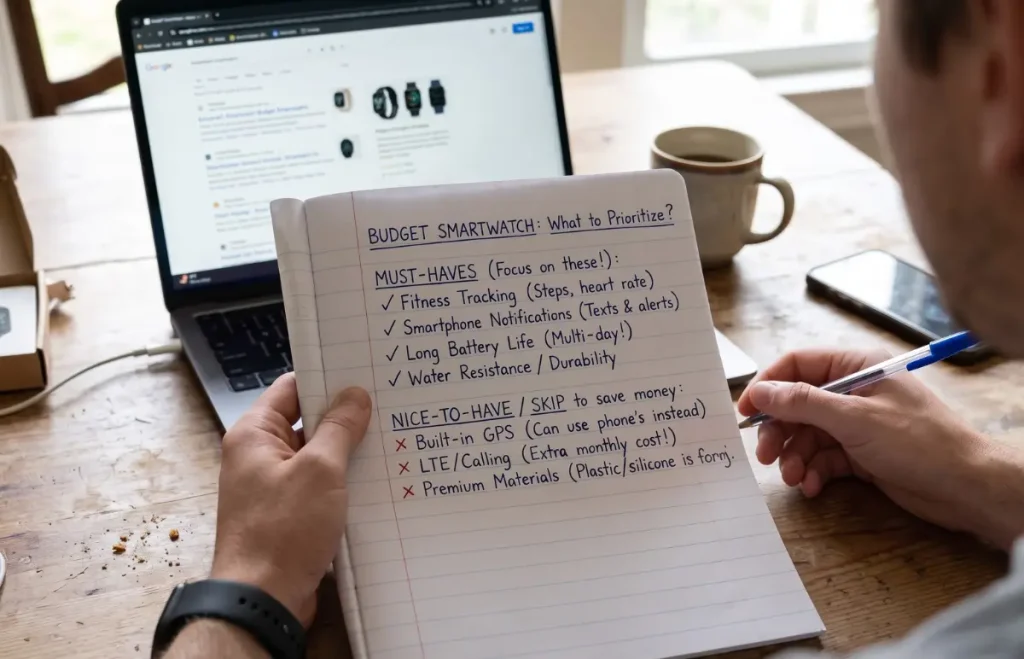
The ideal combination of features will vary from one user to the next, and it is important to consider your own needs before you start looking at the available options. If you are looking for a reliable everyday tool, it is unwise to pay extra for rarely used specifications that barely affect your experience.
| Type of user | Features to prioritise | Features you may not need |
|---|---|---|
| Everyday user | Readable display, notifications, comfortable fit and reliable battery | Advanced sports metrics |
| Fitness enthusiast | Heart rate tracking, workout modes, useful fitness history and battery life | Extensive third-party apps |
| Outdoor runner or cyclist | Built-in GPS, route recording and workout accuracy | Bluetooth calling if you carry your phone |
| Frequent caller | Microphone, speaker, Bluetooth calling and dependable connectivity | Advanced GPS features |
| Swimming enthusiast | Explicit swimming support, suitable water resistance and swim tracking | Features unrelated to exercise |
| Health-conscious user | Consistent measurements, useful trends and a reliable companion app | Unsupported medical claims |
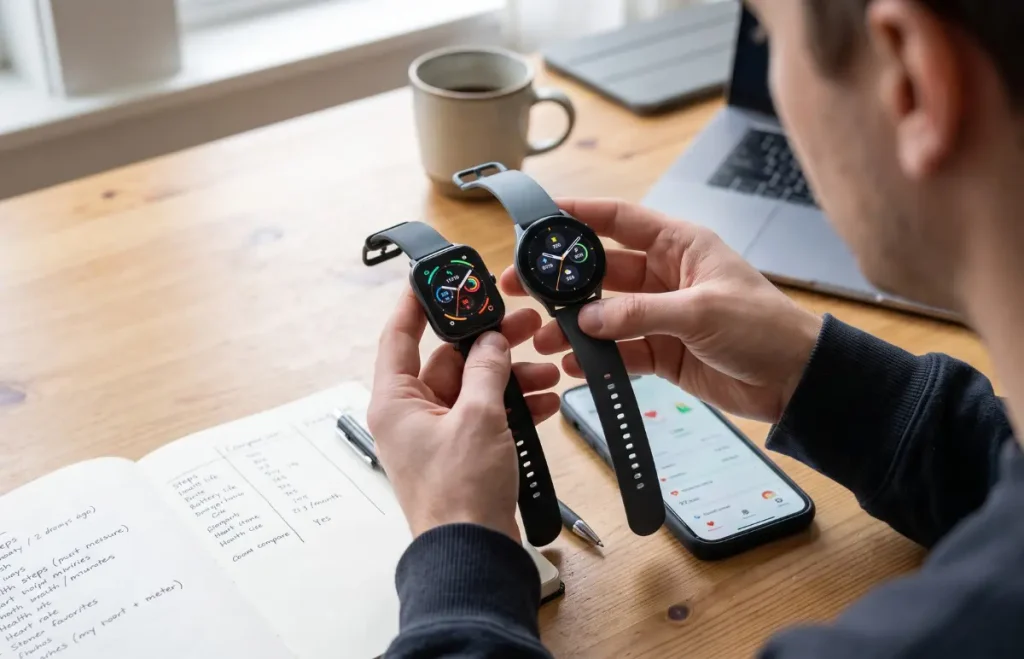
How to Compare Two Budget Smartwatches
Here is a list of steps that can help you compare two budget smartwatches:
1. Set your budget and look at the available options. Pick two or three different smartwatches that fit within your price range.
2. Define your essential features. Make sure to focus on the tools that matter most to you, such as notifications, standalone GPS, swimming support or Bluetooth calling.
3. Look at the real-world battery life rather than simply comparing the advertised specifications. Pay particular attention to the impact that GPS and Bluetooth calling will have on the endurance of the given smartwatch.
4. Take note of the compatibility and app reviews to highlight the potential issues with synchronisation or other problems.
5. Review the warranty and return policy in detail to make sure that there are no issues with coverage or support.
6. Pick the smartwatch that makes it possible to utilise the essential tools without sacrificing too much in terms of other features.
Common Mistakes to Avoid
There are several common mistakes that you should try to avoid when purchasing a budget smartwatch.
- Choosing based on design alone can result in poor battery performance, limited functionality or uncomfortable everyday use.
- Trusting every advertised health feature can create unrealistic expectations about measurement accuracy.
- Ignoring phone compatibility may prevent notifications, calls or app synchronisation from working correctly.
- Assuming every GPS feature is standalone can lead to unexpected dependence on a smartphone.
- Overlooking water resistance limitations can expose the watch to conditions it was not designed to handle.
- Ignoring after-sales support can make repairs, replacements and accessory purchases difficult later
A good budget smartwatch should be defined by its ability to support your most essential tasks within your preferred budget range. Simply put, it should get you more for your money.
Frequently Asked Questions
1. What features to look for in a budget smartwatch?
Look for good battery life, a readable display, smartphone compatibility, reliable notifications, fitness tracking and comfortable build quality. Choose GPS, Bluetooth calling or water resistance based on your needs.
2. How long should a budget smartwatch battery last?
Battery life varies by model and usage. Many budget smartwatches last several days, but GPS, Bluetooth calling and always-on displays can reduce battery life.
3. Are budget smartwatch health readings accurate?
Budget smartwatches provide useful estimates of heart rate, sleep and activity, but accuracy varies. Their readings should not replace medical devices or professional advice.
4. Can I answer calls using a budget smartwatch?
Yes, if the smartwatch supports Bluetooth calling and has a microphone and speaker. Most models require a compatible smartphone connection to handle calls.
5. Is a budget smartwatch suitable for swimming?
Some budget smartwatches support swimming, but not all water-resistant models are suitable for pools. Check the manufacturer’s swimming guidelines and warranty conditions.
6. How much should I spend on a budget smartwatch?
A budget of ₹2,000–₹5,000 is a reasonable starting point for a smartwatch with useful fitness tracking, notifications and a good display. Compare battery life, smartphone compatibility, GPS and warranty before purchasing, as features vary by model. Prices and offers may change.